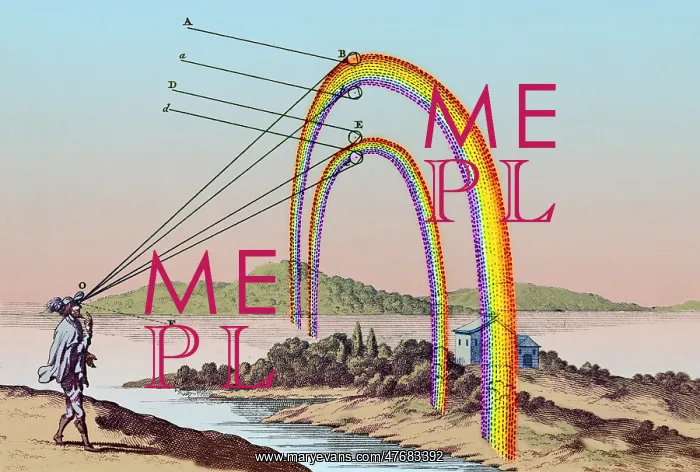
Rene Descartes, Double Rainbow, 1637
Rene Descartes sketch of how primary and secondary rainbows are formed. Theodoric of Freiberg is known to have given an accurate theoretical explanation of both the primary and secondary rainbows in 1307. He explained the primary rainbow, noting that when sunlight falls on individual drops of moisture, the rays undergo two refractions and one reflection before transmission into the eye of the observer. He explained the secondary rainbow through a similar analysis involving two refractions and two reflections. Rene Descartes 1637 treatise, Discourse on Method, further advanced this explanation. Knowing that the size of raindrops did not appear to affect the observed rainbow, he experimented with passing rays of light through a large glass sphere filled with water. By measuring the angles that the rays emerged, he concluded that the primary bow was caused by a single internal reflection inside the raindrop and that a secondary bow could be caused by two internal reflections. He supported this conclusion with a derivation of the law of refraction and correctly calculated the angles for both bows. This image has been enhanced
Pick your License
Restrictions Only for Ireland and United Kingdom
1637 Cartesian Cartesius Coordinate Coordinates Descartes Discourse Enhancement Geometric Geometrical Geometry Method Ocular Optics Primary Rainbow Renatus Secondary Seeing Seventeeth Spectrum Vision
Features In These Collections
> Contributors > PHR