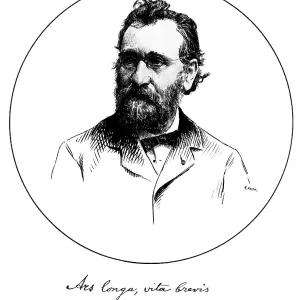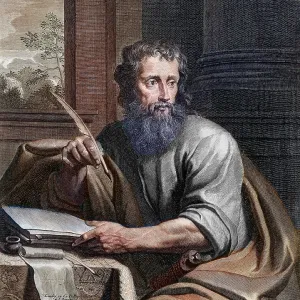

Santiago Ram?n y Cajal, Spanish Neuroscientist
Santiago Ram?n y Cajal (1852-1934) was a Spanish pathologist, histologist, neuroscientist, and Nobel laureate (1906). His pioneering investigations of the microscopic structure of the brain were original: he is considered by many to be the father of modern neuroscience. He was skilled at drawing, and hundreds of his illustrations of brain cells are still used for educational purposes today. Ram?n y Cajal's early work focused on the pathology of inflammation, the microbiology of cholera, and the structure of epithelial cells and tissues, before turning his attention to the central nervous system. He discovered the axonal growth cone, and provided the definitive evidence for what would later be known as neuron theory'. He provided detailed descriptions of cell types associated with neural structures, and produced excellent depictions of structures and their connectivity. He discovered a new type of cell, to be named after him: the interstitial cell of Cajal (ICC). This is not neural or glial, but a cell that is something in between, vitally mediating neurotransmission from nerves to bowel smooth muscle cells. He published over 100 scientific works and articles in French, Spanish, and German. He lived to be 82 and died of natural causes
Pick your License
Restrictions Only for Ireland and United Kingdom
1852 Ather Brain Cajal Cells Cone Enhancement Histologist Histology Interstitial Investigations Laureate Nervous Neuroanatomy Neuron Neuroscience Neuroscientist Nobelist Pathologist Pathology Ram N Ramon Recipient Santiago Skilled Theory
Features In These Collections
> Contributors > PHR