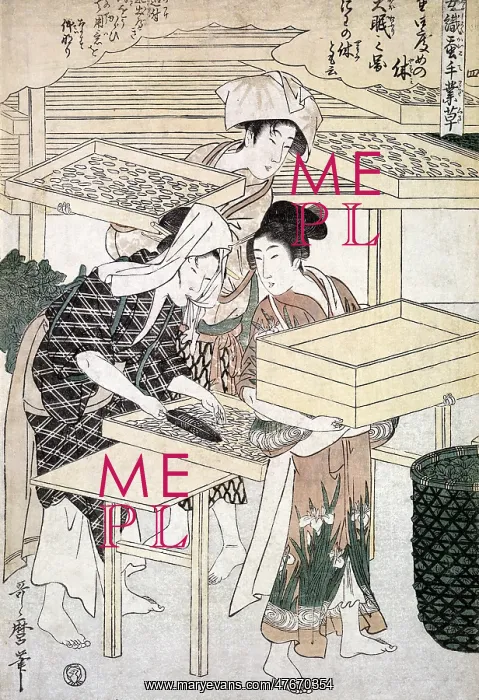
Sorting Silkworm Cocoons, Silk Making in Japan
Three young women with trays of silkworm cocoons. The production of silk originates in China in prehistoric times. Silk remained confined to China until the Silk Road opened at some point during the later half of the first millennium BC. China maintained its virtual monopoly over silk production for another thousand years. Sericulture, or silk farming, is the cultivation of silkworms to produce silk. Although there are several commercial species of silkworms, Bombyx mori (the caterpillar of the domesticated silk moth) is the most widely used and intensively studied silkworm. Silk cultivation spread to Japan around 300 AD, and, by 522 AD, the Byzantines managed to obtain silkworm eggs and were able to begin silkworm cultivation. The Arabs also began to manufacture silk during this same time. The Crusades brought silk production to Western Europe, in particular to many Italian states, which saw an economic boom exporting silk to the rest of Europe. Changes in manufacturing techniques also began to take place during the Middle Ages, with devices such as the spinning wheel first appearing. From the series: Joshoku kaiko tewaza gusa: A series of female handiwork in silk worm production. Utamaro Kitagawa, circa 1799 and 1801
Pick your License
Restrictions Only for Ireland and United Kingdom
Cocoon Cultivate Cultivating Cultivation Eggs Kitagawa Silk-making Silkmaking Silkworm Silkworms Sorting Ukiyo-e Utamaro Woodblock
Features In These Collections
> Contributors > PHR