
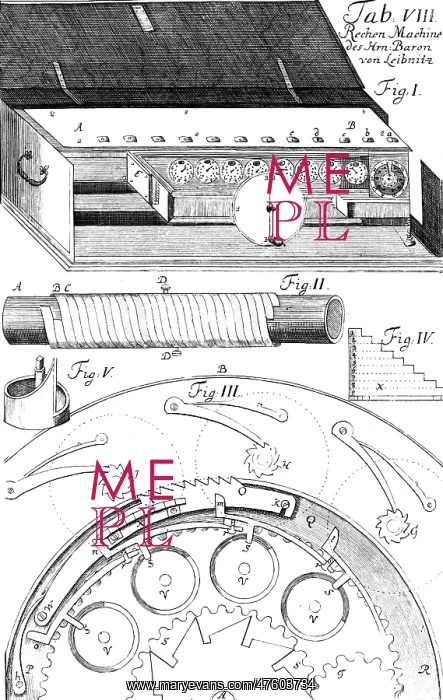
Step Reckoner, Leibniz Mechanical Calculator
Leibniz may have been the first computer scientist and information theorist. The Step Reckoner (or Stepped Reckoner) was a digital mechanical calculator invented by German mathematician Gottfried Wilhelm Leibniz around 1672 and completed in 1694. It was the first calculator that could perform all four arithmetic operations: addition, subtraction, multiplication and division. Its intricate precision gear work, however, was somewhat beyond the fabrication technology of the time; mechanical problems, in addition to a design flaw in the carry mechanism, prevented the machines from working reliably. Despite the mechanical flaws of the Stepped Reckoner, it gave future calculator builders new possibilities. The operating mechanism, invented by Leibniz, called the stepped cylinder or Leibniz wheel, was used in many calculating machines for 200 years, and into the 1970s with the Curta hand calculator
Pick your License
Restrictions Only for Ireland and United Kingdom
Addition Arithmetic Calculating Calculation Calculator Counting Cylinder Diagram Gottfried Leibniz Mass Produced Mass-produced Mechanical Multiplication Schematic Stepped Subtraction
Features In These Collections
> Contributors > PHR