Thales, Ancient Greek Philosopher
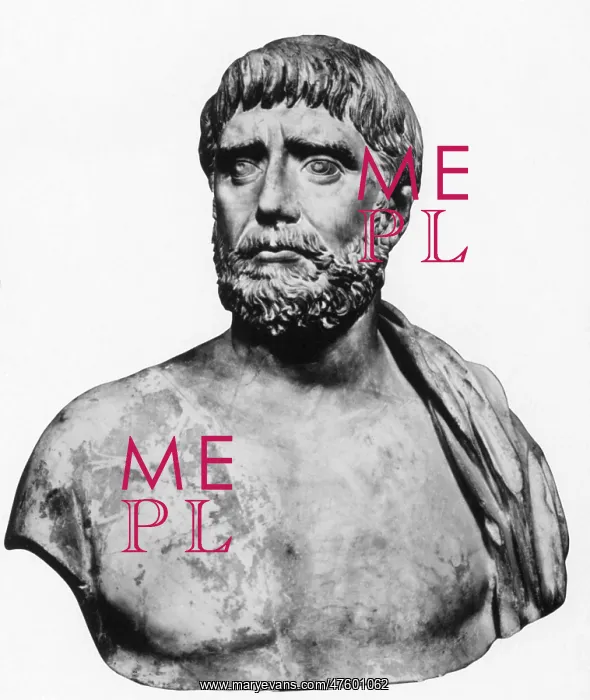
Thales of Miletus (624-546 BC) was a pre-Socratic Greek philosopher, mathematician, astronomer, the first identifiable scientist and one of the Seven Sages of Greece. Thales attempted to explain natural phenomena without reference to mythology and was tremendously influential in this respect. Thales rejection of mythological explanations became an essential idea for the scientific revolution. In mathematics, Thales used geometry to solve problems such as calculating the height of pyramids and the distance of ships from the shore. He is credited with the first use of deductive reasoning applied to geometry, by deriving four corollaries to Thales Theorem. As a result, he has been hailed as the first true mathematician and is the first known individual to whom a mathematical discovery has been attributed. He is reported to have predicted a solar eclipse in 585 BC, and tried to explain earthquakes. Roman copy of a Greek bust from the Museo Capitolino, Rome
Pick your License
Restrictions Only for Ireland and United Kingdom
Astronomer Geometry Identifiable Mathematician Miletus Polymath Pre Socratic Pre-socratic Reasoning Sages Socratic Statuary Thales Theorem
Features In These Collections
> Contributors > PHR