Thomas Savery, Engine to Pump Mine Water, 1699
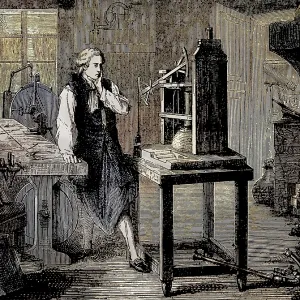
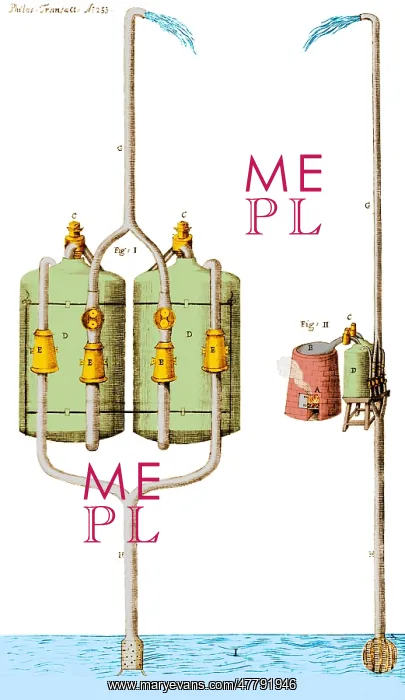
Entitled: The miner's friend, a pump using steam to create a vacuum to draw water from flooded mines; known as Mr. Savery's engine for raising water by the help of fire. Thomas Savery (1650 - 1715) was an English inventor and engineer. In 1698 he patented an early steam engine that had no piston, and no moving parts except from the taps. It was operated by first raising steam in the boiler; the steam was then admitted to the working vessel, allowing it to blow out through a down-pipe into the water that was to be raised. When the system was hot and therefore full of steam the tap between the boiler and the working vessel was shut, and if necessary the outside of the vessel was cooled. This made the steam inside it condense, creating a partial vacuum, and atmospheric pressure pushed water up the down-pipe until the vessel was full. At this point the tap below the vessel was closed, and the tap between it and the up-pipe opened, and more steam was admitted from the boiler. As the steam pressure built up, it forced the water from the vessel up the up-pipe to the top of the mine. He wanted to use the engine to pump water from mines, but most proved to be too deep for the machine to be effective
Pick your License
Restrictions Only for Ireland and United Kingdom
1699 Diagram Enhance Flooded Hydraulic Inventions Mines Savery Steam-powered Turbine
Features In These Collections
> Contributors > PHR