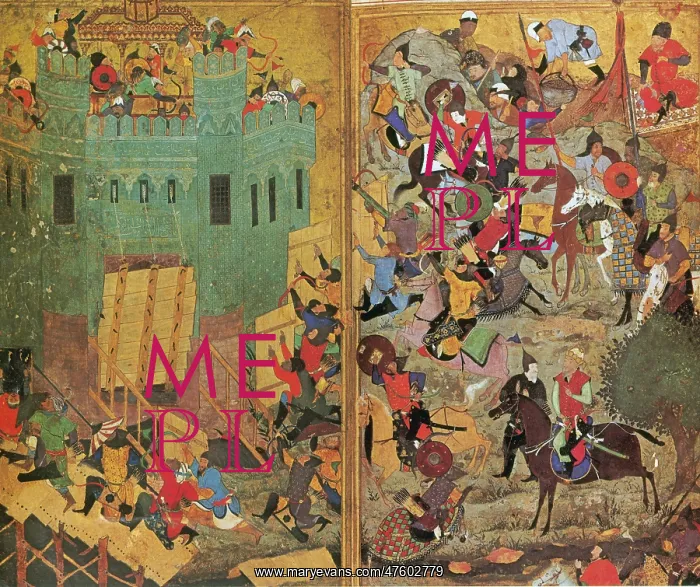
Timur and the Siege of Smyrna, 1402
15th century miniatures show Tamerlane besieging the Hospitalers castle at Smyra an ancient city located at a central and strategic point on the Aegean coast of Anatolia. The drawbridge has been raised, but the Muslim troops have made another bridge on the right. Soldiers with wooden shields rush the wall. In the upper right corner a mine is being dug. In the lower right Tamerlane, in red, is on horseback. Smyrna had been captured from the Turks by the Knights of St. John (the Hospitallers) in 1344, and since then had resisted a number of Ottoman assaults. The siege only lasted for fifteen days. During that time Tamerlane's men blocked the harbour entrance with stones, preventing any more reinforcements from arriving, while the walls were pounded by siege engines and undermined. Finally, in December 1402 the city fell to an assault. As was almost always the case when he took a city by storm, Tamerlane ordered a massacre of the population and destroyed the fortifications. Timur (1336-1405), historically known as Tamerlane, was a Turk who conquered West, South and Central Asia, and the founder of the Timurid dynasty. Timur envisioned the restoration of the Mongol Empire of Genghis Khan. He was also a devout Muslim and referred to himself as the Sword of Islam. His armies were multi-ethnic and multicultural, ferocious and feared throughout Asia, Africa, and Europe. Timur is regarded as a military genius and a tactician whose prowess made him one of the world's great conquerors. He was also a great patron of art and architecture. Timur died during an uncharacteristic winter campaign against the ruling Chinese Ming Dynasty in 1405 at the age of 68