

 : Trojan Horse


Trojan Horse

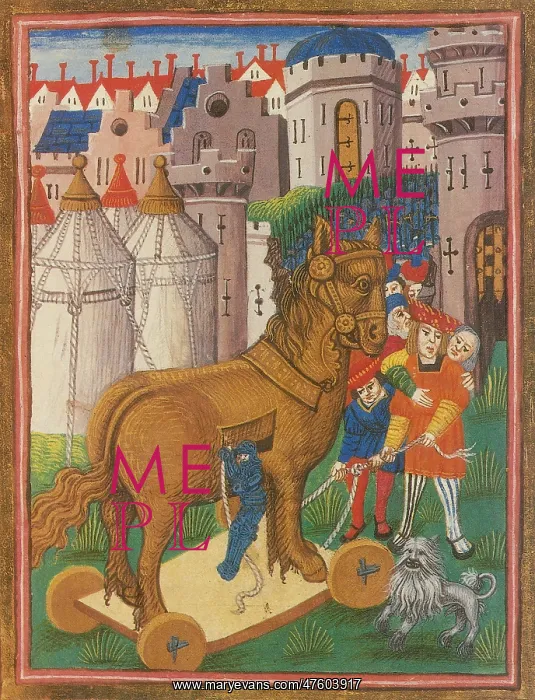
The Trojan Horse from a late 15th century illustration of the poet John Lydgate's Troy Book. The Trojan Horse is a tale from the Trojan War about the stratagem that allowed the Greeks to finally enter the city of Troy and end the conflict. In the canonical version, after a fruitless 10-year siege, the Greeks constructed a huge wooden horse, and hid a select force of men inside. The Greeks pretended to sail away, and the Trojans pulled the horse into their city as a victory trophy. That night the Greek force crept out of the horse and opened the gates for the rest of the Greek army, which had sailed back under cover of night. The Greeks entered and destroyed the city of Troy, decisively ending the war. Ancient Greeks believed that the events Homer related were true and that Troy was located in the vicinity of the Dardanelles in what is now north-western Turkey. In 1870, German archaeologist Heinrich Schliemann excavated a site in this area which he believed to be the site of Troy, and at least some archaeologists agree. There remains no evidence that Homer's Troy ever existed, or that any of the events of the Trojan War took place. Many historians believe that the Homeric stories are a fusion of sieges and expeditions by the Greeks of the Bronze Age or Mycenean period, and do not describe actual events. Those who think that the stories of the Trojan War derive from a specific historical conflict usually date it to between 1300 BC and 1200 BC

Picture No
10803324
Media ID
47603917
Size
3053px x 3992px (13.7MB)
Credit
©Photo Researchers / Mary Evans Picture Library
Source
Photo Researchers

Pick your License

Please tell us the book title or ISBN

Please supply intended use


Restrictions Only for Ireland and United Kingdom

Legendary Lydgate Trojan Troy


Features In These Collections

> Contributors > PHR

You May Also Like


Gallery Wall Inspiration

Ilya Ilyich Mechnikov, Russian Immunologist
Laughing Gas, Nitrous Oxide
James Watt, Scottish Inventor and Engineer
Asteriornis ancient bird, illustration
Hesperornis ancient bird, illustration
Icthyornis ancient bird, illustration
Confuciusornis sanctus ancient bird, illustration
Deinonychus ancient bird art, illustration
Laughing Gas, Nitrous Oxide
Thames Water Drop, 1850
Michael Faraday and Father Thames, 1855
Thames Water Drop, 1850
Michael Faraday and Father Thames, 1855
Cellular Plant Tissue, Matthias Jakob Schleiden, 1847
Henry Maudsley, British Psychiatrist
Swimming Manual, Digby, 1587
Russian Pirates, 1805
Ilya Ilyich Mechnikov, Russian Immunologist
Johnny Appleseed, American Nurseryman
Saint Paul, Christian Apostle
James Fenimore Cooper, American Author
Arthrobotrys, SEM
Rhizopus sexualis, SEM
Flint Hatchet, Stone Age Tool


© Copyright Mary Evans Picture Library - All Rights Reserved 2026
Powered by Media Storehouse®
We accept all major payment options so you can pay for the things you need in the way that is most convenient for you
Facebook     Twitter     Instagram