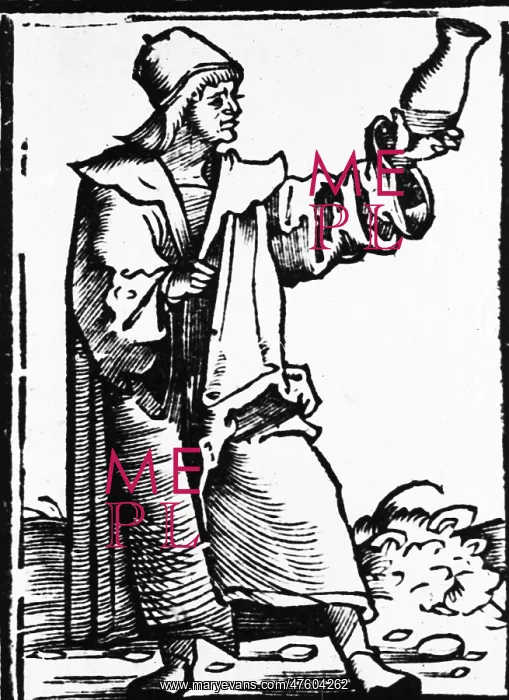
Urine Analysis, 1519
A 16th-century engraving of a doctor examining a glass vessel containing a sample of a patient's urine. In medieval medicine, uroscopy was an important diagnostic tool, urine having 29 attributes to be observed. From this the physician deduced the supposed levels of a patient's four humors (bodily fluids): blood, yellow bile, black bile and phlegm. Illness was thought to be due to an imbalance in these fluids. It was thought that the imbalance could be redressed by changing the patient's diet, prescribing medicine, by bleeding the patient, or by surgery. Image drawn by Lorenz Fries of Colmar, Germany, in 1519
Picture No
10803624
Media ID
47604262
Size
2700px x 3708px
(1.5MB)
Credit
©Photo Researchers / Mary Evans Picture Library
Source
Photo Researchers
Pick your License
Restrictions Only for Ireland and United Kingdom
1500s 1519 Analysis Diagnosis Diagnostic Urine Uroscopy
Features In These Collections
> Contributors > PHR