Uroscopy, 1519
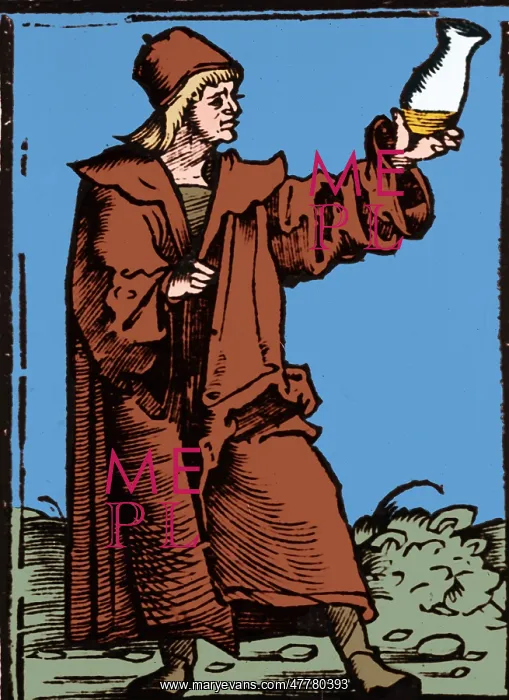
Doctor examining a glass vessel containing a sample of a patient's urine. Uroscopy allowed doctors to diagnose patients without technology. All that was needed was a uroscopy wheel, uroscopy flask, and an experienced doctor to be able to give a diagnosis. It was a very simple procedure that a doctor could determine a patients problem by simply tasting and/or looking at their urine. In medieval medicine, uroscopy was an important diagnostic tool, urine having 29 attributes to be observed. From this the physician deduced the supposed levels of a patient's four humors (bodily fluids): blood, yellow bile, black bile and phlegm. Illness was thought to be due to an imbalance in these fluids. By modern medical standards, uroscopy is considered to be a very limited means of obtaining evidence for the correct diagnosis of a patient's condition. Many of the assumptions made by ancient physicians regarding uroscopy have proved to be quite incorrect and unscientific. Image drawn by Lorenz Fries of Colmar, Germany, in 1519