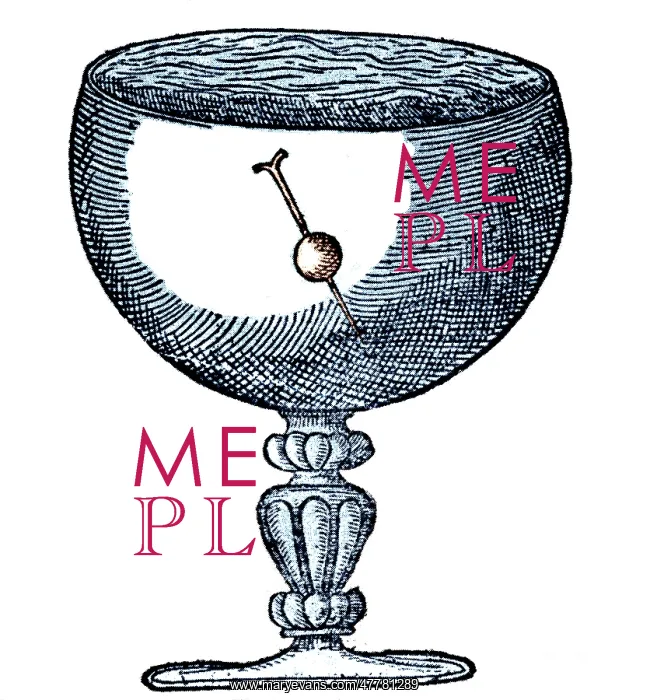


 : William Gilbert, Magnetic Dip Experiment, 1600


William Gilbert, Magnetic Dip Experiment, 1600

Illustration from De Magnete by Gilbert, published in 1600 showing a magnetic needle slanting at the dip angle when suspended in water with just enough buoyancy to keep it hovering. Magnetic dip is the angle made with the horizontal by the compass needle of a vertically held compass. This angle varies at different points on the Earth's surface. Magnetic dip results from the tendency of a magnet to align itself with lines of force. As the Earth's magnetic lines of force are not parallel to the surface, the north end of a compass needle will point downward on the northern hemisphere (positive dip) or upward on the southern hemisphere (negative dip). William Gilbert (May 24, 1544 - November 30, 1603) was an English physician, physicist and natural philosopher. He was the first to argue that the center of the Earth was iron, and he considered an important and related property of magnets was that they can be cut, each forming a new magnet with north and south poles. He invented the first electrical measuring instrument, the electroscope, in the form of a pivoted needle he called the versorium. He died in 1603 at the age of 59. His cause of death is thought to have been the bubonic plague

Picture No
13343682
Media ID
47781289
Size
3600px x 3874px (5.3MB)
Credit
© Science Source / Mary Evans Picture Library
Usage Restrictions
Commercial sales may require 3rd party clearance
Source
Science Source

Pick your License

Please tell us the book title or ISBN

Please supply intended use


Restrictions Only for Ireland and United Kingdom

Compass Density Geomagnetism Geophysics Goblet Inclination Magnet Magnete Magnetic Magnetism Needle Poles


Features In These Collections

> Contributors > PHR
Gallery Wall Inspiration

Ilya Ilyich Mechnikov, Russian Immunologist
Laughing Gas, Nitrous Oxide
James Watt, Scottish Inventor and Engineer
Asteriornis ancient bird, illustration
Hesperornis ancient bird, illustration
Icthyornis ancient bird, illustration
Confuciusornis sanctus ancient bird, illustration
Deinonychus ancient bird art, illustration
Laughing Gas, Nitrous Oxide
Thames Water Drop, 1850
Michael Faraday and Father Thames, 1855
Thames Water Drop, 1850
Michael Faraday and Father Thames, 1855
Cellular Plant Tissue, Matthias Jakob Schleiden, 1847
Henry Maudsley, British Psychiatrist
Swimming Manual, Digby, 1587
Russian Pirates, 1805
Ilya Ilyich Mechnikov, Russian Immunologist
Johnny Appleseed, American Nurseryman
Saint Paul, Christian Apostle
James Fenimore Cooper, American Author
Arthrobotrys, SEM
Rhizopus sexualis, SEM
Flint Hatchet, Stone Age Tool


© Copyright Mary Evans Picture Library - All Rights Reserved 2026
Powered by Media Storehouse®
We accept all major payment options so you can pay for the things you need in the way that is most convenient for you
Facebook     Twitter     Instagram