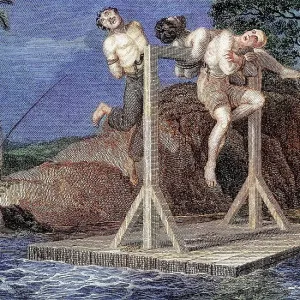

William Spiggot Suffers Peine forte et dure, 1721
William Spiggot was an 18th century English highwayman. During his trial, he at first refused to plead and was sentenced to be pressed until he pleaded. This was called Peine forte et dure. He was later executed, after a second trial when he pleaded not guilty, on February 11, 1721. Peine forte et dure (hard and forceful punishment) was a method of torture formerly used in the common law legal system, in which a defendant who refused to plead would be subjected to having heavier and heavier stones placed upon his or her chest until a plea was entered, or the defendant died. Many defendants charged with capital offenses would refuse to plead in order to avoid forfeiture of property. If the defendant pleaded either guilty or not guilty and was executed, their heirs would inherit nothing. If they refused to plead their heirs would inherit their estate, even if they died in the process. Peine forte et dure was abolished in Great Britain in 1772, with the last known actual use of the practice having been in 1741. Torture is the act of deliberately inflicting physical or psychological pain in order to fulfill some desire of the torturer or compel some action from the victim
Pick your License
Restrictions Only for Ireland and United Kingdom
1700s 1720s 1721 Confession Cruel Cruelty Dure Eighteenth Forced Forceful Forte Highwayman Infamous Inhumane Inhumanity Interrogate Interrogation Method Notorious Peine Persecute Persecuted Persecuting Persecution Pressing Punish Punishing Robber Suffering Torturer Torturing
Features In These Collections
> Contributors > PHR