Woodcut, 1750
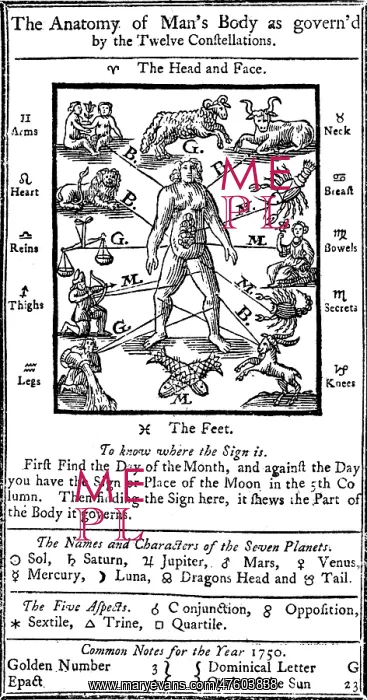
Woodcut titled The Anatomy of Man's Body as govern'd by the Twelve Constellations from Benjamin Franklin, Poor Richard's Almanack, Philadelphia, 1750. Medical astrology is an ancient medical system that associates various parts of the body, diseases, and drugs as under the influence of the sun, moon, and planets, along with the twelve astrological signs. Each of the astrological signs is associated with different parts of the human body. The underlying basis for medical astrology, astrology itself, is considered to be a pseudoscience or superstition as there is no scientific basis for its core beliefs. The Zodiac Man or homo signorum was used in anatomical diagrams dating from ancient times to the later medieval period. The human body was believed to be linked to the heavens during this period. This was often illustrated with the Zodiac Man, who had every part of his body linked with an astrological sign. The astrological sign was linked to humorism alongside the weather. As well as the Zodiac man being intimately linked with heaven it was also the common drawing of the human body at the time. The underlying basis for medical astrology, astrology itself, is considered to be a pseudoscience or superstition as there is no scientific basis for its core beliefs. Zodiac to body part is as follows: Aries: head, face, brain, eyes, Taurus: throat, neck, thyroid gland, vocal tract, Gemini: arms, lungs, shoulders, hands, nervous system, brain, Cancer: chest, breasts, stomach, alimentary canal, Leo: heart, chest, spine, spinal column, upper back, Virgo: digestive system, intestines, spleen, nervous system, Libra: kidneys, skin, lumbar region, buttocks, Scorpio: reproductive system, sexual organs, bowels, excretory system, Sagittarius: hips, thighs, liver, sciatic nerve, Capricorn: knees, joints, skeletal system, Aquarius: ankles, calves, circulatory system, Pisces: feet, toes, lymphatic system, adipose tissue
Pick your License
Restrictions Only for Ireland and United Kingdom
1750 Almanack Anatomical Arteries Astrological Astrology Constellations Diagram Govern Homo Iatromathematics Pseudoscience Superstition Symbolism Vein Veins Zodiac
Features In These Collections
> Contributors > PHR