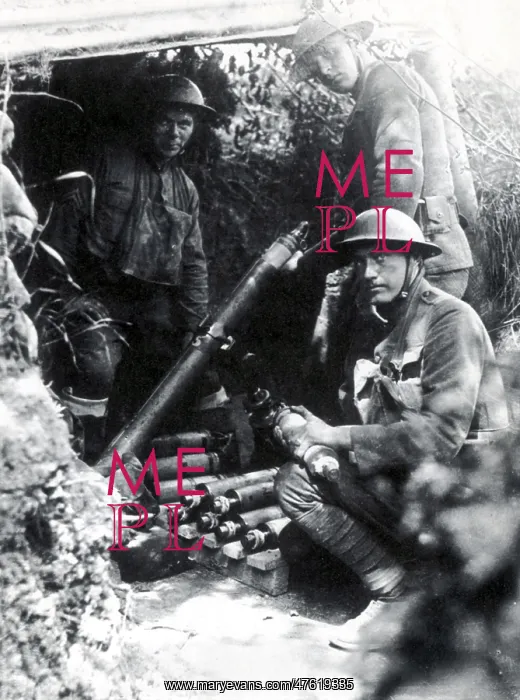
WWI, AEF Stokes Mortar Crew
"The British made Stokes Mortar could fire as many as 25 bombs per minute and had a maximum range of 800 yards. Extremely useful in the muddy trenches of the Western Front, mortars were praised because of the bombs high angle of flight, A mortar round could be aimed to fall directly into trenches where artillery shells, due to their low angle of flight, could not possibly go. During WWI, they were the scene of severe and almost continuous fighting. At the outbreak of the war, the United States pursued a policy of non-intervention, avoiding conflict while trying to broker a peace. After the sinking of seven U.S. merchant ships by submarines, Wilson called for war on Germany, which the Congress declared on April 6, 1917. The United States was never formally a member of the Allies but became a self-styled "Associated Power". The United States had a small army, but, after the passage of the Selective Service Act, it drafted 2.8 million men, and, by summer 1918, was sending 10, 000 fresh soldiers to France every day. The AEF helped the French Army on the Western Front during the Aisne Offensive (at Chateau-Thierry and Belleau Wood) in June 1918, and fought its major actions in the Saint-Mihiel and Meuse-Argonne Offensives in late 1918. At 11 o'clock in the morning of the 11th day of the 11th month of 1918, the WWI, known at the time as the Great War, came to an end."
Pick your License
Restrictions Only for Ireland and United Kingdom
Dogface Doughboy Expeditionary Infantryman Infantrymen Mortar Munitions Stokes Weaponry
Features In These Collections
> Contributors > PHR