

 : WWI, BEF Motor Machine Gun Service


WWI, BEF Motor Machine Gun Service

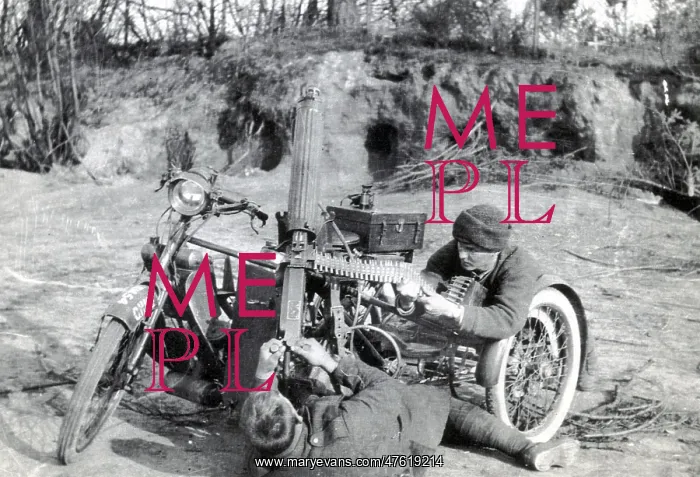
Although the usefulness of the machine gun had not been fully appreciated by the British Army before the outbreak of WWI, it soon became apparent that highly-mobile machine gun units would be of considerable value in the fluid warfare that characterized the first few weeks of the war. The formation of batteries of motorcycle-mounted machine guns was authorized in 1914. These batteries were designated part of the Royal Field Artillery, one battery being allocated to the divisional Artillery of each Division of the British Expeditionary Force. Each battery consisted of 18 motorcycle/sidecar combinations, carrying six Vickers machine guns, ammunition and spare parts, eight motorcycles without sidecars, and two or three cars or trucks. Members were recruited from Motor Cycle Clubs and officers seconded from other regiments. In 1915, as the war bogged down in the stalemate of trench warfare, the mobility of these batteries became of lesser importance, and the service was incorporated into the Motor Machine Gun Service (MMGS) as the Machine Gun Corps (MGS).(Motors)

Picture No
10978365
Media ID
47619214
Size
4050px x 2757px (1.9MB)
Credit
© Photo Researchers / Mary Evans~~
Source
Photo Researchers

Pick your License

Please tell us the book title or ISBN

Please supply intended use


Restrictions Only for Ireland and United Kingdom

Expeditionary Gunnery Mobile Munitions Weaponry


Features In These Collections

> Contributors > PHR
Gallery Wall Inspiration

Ilya Ilyich Mechnikov, Russian Immunologist
Laughing Gas, Nitrous Oxide
James Watt, Scottish Inventor and Engineer
Asteriornis ancient bird, illustration
Hesperornis ancient bird, illustration
Icthyornis ancient bird, illustration
Confuciusornis sanctus ancient bird, illustration
Deinonychus ancient bird art, illustration
Laughing Gas, Nitrous Oxide
Thames Water Drop, 1850
Michael Faraday and Father Thames, 1855
Thames Water Drop, 1850
Michael Faraday and Father Thames, 1855
Cellular Plant Tissue, Matthias Jakob Schleiden, 1847
Henry Maudsley, British Psychiatrist
Swimming Manual, Digby, 1587
Russian Pirates, 1805
Ilya Ilyich Mechnikov, Russian Immunologist
Johnny Appleseed, American Nurseryman
Saint Paul, Christian Apostle
James Fenimore Cooper, American Author
Arthrobotrys, SEM
Rhizopus sexualis, SEM
Flint Hatchet, Stone Age Tool


© Copyright Mary Evans Picture Library - All Rights Reserved 2026
Powered by Media Storehouse®
We accept all major payment options so you can pay for the things you need in the way that is most convenient for you
Facebook     Twitter     Instagram