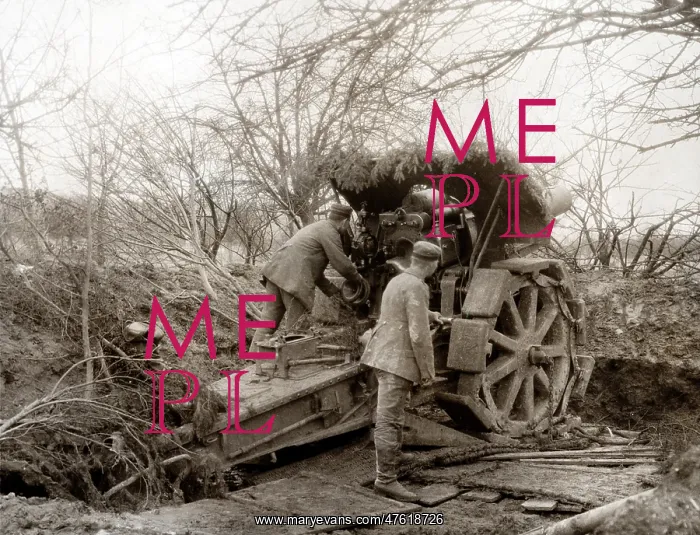


 : WWI, Camouflaged Howitzer, 1915


WWI, Camouflaged Howitzer, 1915

Soldiers at howitzer camouflaged with evergreen branches. The early 20th century saw the introduction of super-heavy siege howitzers. They were transported mechanically rather than by teams of horses and had to be assembled on their firing position. The onset of trench warfare after the first few months of WWI greatly increased the demand for howitzers that gave a steep angle of descent, which were better suited than guns to the task of striking targets in a vertical plane (such as trenches), with large amounts of explosive and considerably less barrel wear. The German army was well equipped with howitzers, having far more at the beginning of the war than France. The French slang word camouflage came into common English usage during WWI when the concept of visual deception developed into an essential part of modern military tactics. In that war, long-range artillery and observation from the air combined to expand the field of fire, and camouflage was widely used to decrease the danger of being targeted or to enable surprise. Unknown photographer dated November 30, 1915
Picture No
10978241
Media ID
47618726
Size
4200px x 3209px (3.7MB)
Credit
© Photo Researchers / Mary Evans~~
Source
Photo Researchers
Date
1915

Pick your License

Please tell us the book title or ISBN

Please supply intended use


Restrictions Only for Ireland and United Kingdom

Deception Gunnery Howitzer Jerries Munitions Tactics Weaponry


Features In These Collections

> Contributors > PHR

Gallery Wall Inspiration

Ilya Ilyich Mechnikov, Russian Immunologist
Laughing Gas, Nitrous Oxide
James Watt, Scottish Inventor and Engineer
Asteriornis ancient bird, illustration
Hesperornis ancient bird, illustration
Icthyornis ancient bird, illustration
Confuciusornis sanctus ancient bird, illustration
Deinonychus ancient bird art, illustration
Laughing Gas, Nitrous Oxide
Thames Water Drop, 1850
Michael Faraday and Father Thames, 1855
Thames Water Drop, 1850
Michael Faraday and Father Thames, 1855
Cellular Plant Tissue, Matthias Jakob Schleiden, 1847
Henry Maudsley, British Psychiatrist
Swimming Manual, Digby, 1587
Russian Pirates, 1805
Ilya Ilyich Mechnikov, Russian Immunologist
Johnny Appleseed, American Nurseryman
Saint Paul, Christian Apostle
James Fenimore Cooper, American Author
Arthrobotrys, SEM
Rhizopus sexualis, SEM
Flint Hatchet, Stone Age Tool


© Copyright Mary Evans Picture Library - All Rights Reserved 2026
Powered by Media Storehouse®
We accept all major payment options so you can pay for the things you need in the way that is most convenient for you
Facebook     Twitter     Instagram