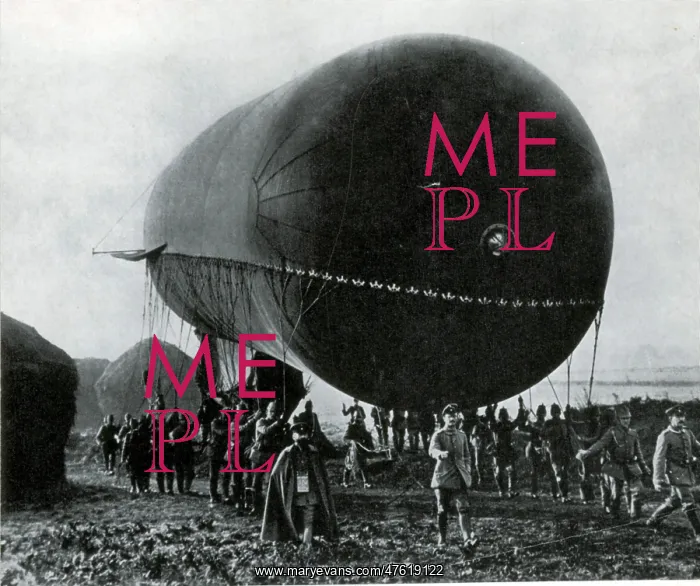
WWI, German Observation Balloon
"Observation balloons are balloons that are employed as aerial platforms for intelligence gathering and artillery spotting. During WWI both the Allies and Germany employed balloons, generally a few miles behind the front lines. Positioning artillery observers at altitude on balloons allowed them to see targets at greater range than they could on the ground. This allowed the artillery to take advantage of its increased range. Because of their importance as observation platforms, balloons were heavily defended by anti-aircraft guns and patrolling fighter aircraft. The balloons were fabric envelopes filled with hydrogen gas, whose flammable nature led to the destruction of hundreds of balloons on both sides. Observers manning these observation balloons frequently had to use a parachute to evacuate their balloon when it came under attack. Observation crews, were the first to use parachutes on a wide scale, long before they were adopted by fixed wing aircraft. Caption: "A German unit walks a small observation balloon to its launching site in a hayfield. The canvas gondola at the balloon's stern carried aloft two observers, usually to a height of 2, 000 feet. The balloons were held to the ground by cables, and when attacked were quickly winched in. Because of their heavy fighter protection, the big gasbags were sometimes considered to be tougher game than airplanes."
Pick your License
Restrictions Only for Ireland and United Kingdom
Dirigeable Dirigible Intelligence Spotting Steerable
Features In These Collections
> Contributors > PHR