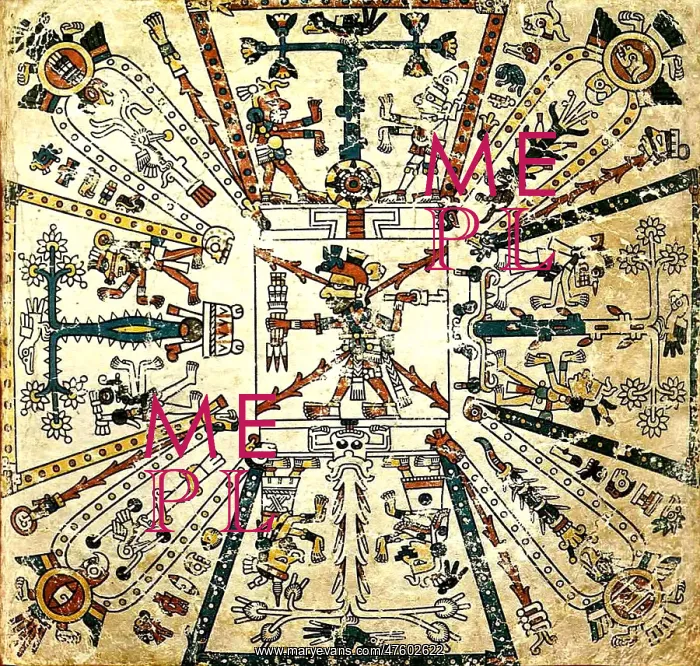
Xiuhtecuhtli, Aztec God of Fire, Codex Fej?rviry-Mayer, 15th
Codex Fej?rvary-Mayer depicts specific aspects of the tonalpohualli the 260-day Mesoamerican augural cycle. The painted manuscript divides the world into five parts. T-shaped trees delineate compass points: east at the top, west on the bottom, north on the left, and south on the right. The four directions are distributed around a sacred center, shown here as Xiuhtecuhlti. In Aztec mythology, Xiuhtecuhtli was the god of fire, day and heat.The senior-deity of the Aztec pantheon. He was the lord of volcanoes, the personification of life after death, warmth in cold (fire), light in darkness and food during famine. At the end of a 52-year cycle it was feared that the gods would discontinue their contract with mankind. To appease them, at the end of such a cycle feasts were held in their honor, where Xiuhtecuhtli as the god of fire was the center of their attention. The Codex Fej?rvary-Mayer is an Aztec Codex of central Mexico. It is one of the rare pre-Hispanic manuscripts that have survived the Spanish conquest of Mexico. As a typical calendar codex tonalamatl dealing with the sacred Aztec calendar. Its elaboration is typically pre-Columbian: it is made on deerskin parchment folded accordion-style into 23 pages
Pick your License
Restrictions Only for Ireland and United Kingdom
Aztec Aztlan Calendar Codex Codices Coldness Columbian Deerskin Deity Famine Icon Iconography Legendary Mayer Mesoamerica Mesoamerican Nahuas Nahuatl Pantheon Parchment Personification Pictorial Pre Columbian Pre-columbian Turquoise Volcanoes Warmth Xiuhtecuhtli
Features In These Collections
> Contributors > PHR