
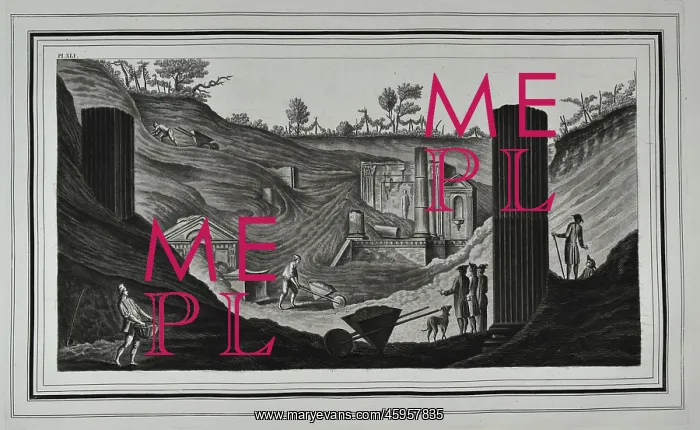
Discovery of the temple of Isis at Pompeii
Plate XLI: View of the first discovery of the temple of Isis at Pompeii, which city was buried by showers of pumice stones and other volcanick (sic) matter, during the great eruption of mount Vesuvius in the year 79 of the Christian aera. by Pietro Fabris (fl 1740-1792). The source of this plate, Campi Phlegraei, is a first hand account of the eruptions witnessed by Sir William Hamilton (1730-1803), British envoy to Naples between 1764-1767. Originally published in three volumes (1776-1779), the title took its name from the area around Naples popularly referred to as Campi Phlegraei or flaming fields, owing to the frequent and violent eruptions of Mount Vesuvius. Hand coloured etching
Picture No
14154168
Media ID
45957835
Size
5366px x 3300px
(2.1MB)
Credit
© The Geological Society / Mary Evans
Source
Geological Society of London. Hamilton, W, Campi Phlegraei, ou, observations sur les volcans des Deux Siciles'. Nouvelle ed. edn. Paris: Chez Lamy, (1799) - Image reference: 02-39
Date
1799








![Earliest geological map of Ireland [1814]](/sq/800/earliest-geological-map-ireland-1814-48658336.jpg.webp "Earliest geological map of Ireland [1814]")


![Draft of the first geological map of Jersey [c.1828]](/sq/800/draft-first-geological-map-jersey-c1828-48658294.jpg.webp "Draft of the first geological map of Jersey [c.1828]")
![First geological map of Jersey [c.1828]](/sq/800/first-geological-map-jersey-c1828-48658274.jpg.webp "First geological map of Jersey [c.1828]")

![First Geological Map of Scotland [1808]](/sq/800/first-geological-map-scotland-1808-48658245.jpg.webp "First Geological Map of Scotland [1808]")


