
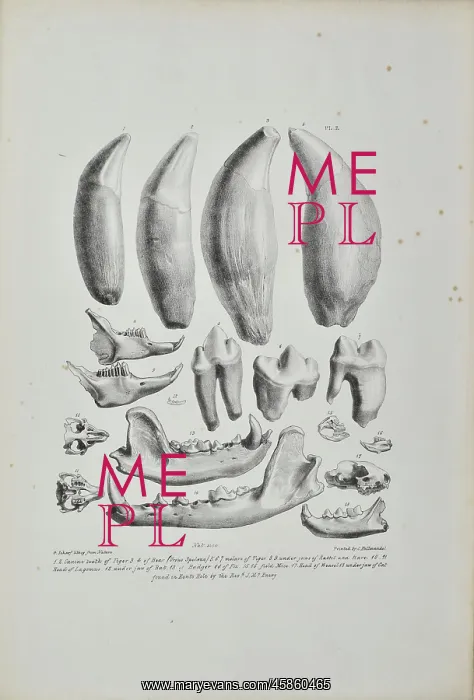
Teeth and jaws from Kent's Cavern
Teeth of tigers and bears Ursus spelaeus) with jaws from a rabbit, hare, bat, badger, fox, field mice, weasel and cat found in Kent's Hole by the Rev J McEnery, drawn by George Scharf (1788-1860). Kent's Cavern, in Torquay, had long attracted visitors as a natural curiosity but first came to scientific prominence in 1824 when a tourist Mr J Northmore was recommended to visit the site in his pursuit of possible Mithraic artefacts. There were no signs of druids but he did find mammalian remains. The Rev William Buckland (1784-1856) had been conducting excavations in other bone caves during this period and was therefore alerted. Not having the time to oversee the project himself, Buckland encouraged the Roman Catholic priest Father John MacEnery (1797-1841) to undertake the excavations. Between 1825-1829 McEnery found the bones of extinct animals such as bears, hyaenas, rhinoceros and deer. Most controversially MacEnery claimed to have found evidences of man-made flints in amongst the animal bones. Lithograph
Pick your License
1784-1856 1788-1860 1797-1841 1824 1825-1829 Alerted Amongst Artefacts Attracted Badger Bones Buckland Cavern Caves Claimed Conducting Controversially Curiosity Druids Encouraged Evidences Excavations Flints Fossils Geological Hare Hyaenas Jaws Macenery Mammalian Man-made Mcenery Mice Mithraic Northmore Oversee Palaeontology Possible Prominence Pursuit Recommended Rhinoceros Scharf Spelaeus Therefore Tigers Torquay Undertake Ursus Weasel
Features In These Collections
> Contributors > GSO





![Earliest geological map of Ireland [1814]](/sq/800/earliest-geological-map-ireland-1814-48658336.jpg.webp "Earliest geological map of Ireland [1814]")


![Draft of the first geological map of Jersey [c.1828]](/sq/800/draft-first-geological-map-jersey-c1828-48658294.jpg.webp "Draft of the first geological map of Jersey [c.1828]")
![First geological map of Jersey [c.1828]](/sq/800/first-geological-map-jersey-c1828-48658274.jpg.webp "First geological map of Jersey [c.1828]")

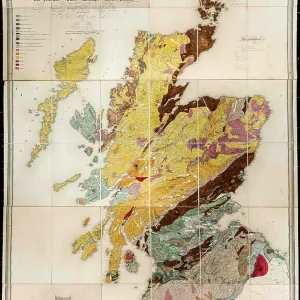
![First Geological Map of Scotland [1808]](/sq/800/first-geological-map-scotland-1808-48658245.jpg.webp "First Geological Map of Scotland [1808]")


